



Date:2026-04-21
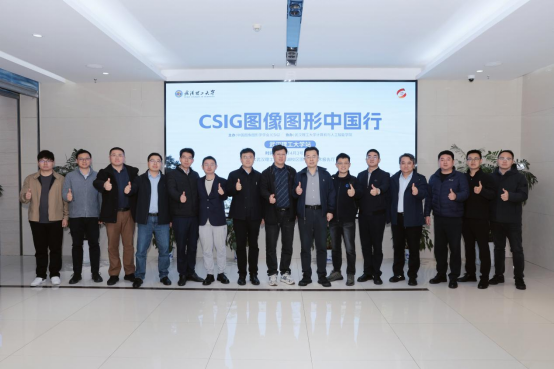
On the morning of April 3, the academic event “CSIG Image and Graphics China Tour” was successfully held in the Academic Lecture Hall of Nanhu Library. The event was hosted by the China Society of Image and Graphics (CSIG) and organized by the School of Computer Science and Artificial Intelligence of Wuhan University of Technology. The theme of the event was “From Multimodal Large Models to Embodied Intelligence: Key Breakthroughs Toward Real-World Intelligence.” Luo Rong, Vice President of Wuhan University of Technology, attended the event. More than 200 participants, including leading experts and scholars in the field of artificial intelligence from across China, as well as faculty and student representatives from the university, took part in this academic gathering.
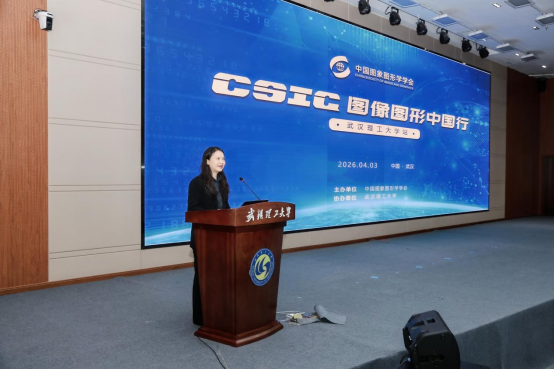
Luo Rong delivered a welcome speech, extending a warm welcome to the attending experts and expressing sincere gratitude to the China Society of Image and Graphics. She introduced the university’s overall development as a national key university directly under the Ministry of Education and as an institution included in both the “211 Project” and the “Double First-Class” initiative. She also highlighted the achievements of the School of Computer Science and Artificial Intelligence in discipline development, talent cultivation, and scientific research innovation. She stated that the university hopes to take this event as an opportunity to deepen cooperation with domestic peers, focus on key areas such as multimodal intelligence and embodied intelligence, and contribute the university’s strength to China’s scientific and technological self-reliance and self-improvement.
During the keynote session, several leading experts in image, graphics, and artificial intelligence shared their latest research findings on frontier topics including multimodal large models, low-altitude drone perception, general intelligence frameworks, and embodied intelligence.
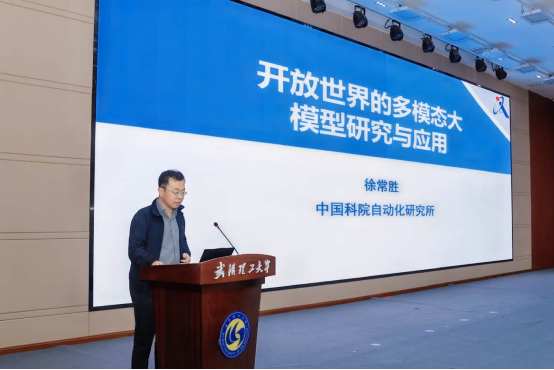
Professor Xu Changsheng from the Institute of Automation, Chinese Academy of Sciences, delivered a report titled “Research and Applications of Multimodal Large Models in the Open World.” He provided an in-depth analysis of key challenges faced by multimodal large models in open environments, such as data heterogeneity and knowledge transfer, and shared related application explorations.
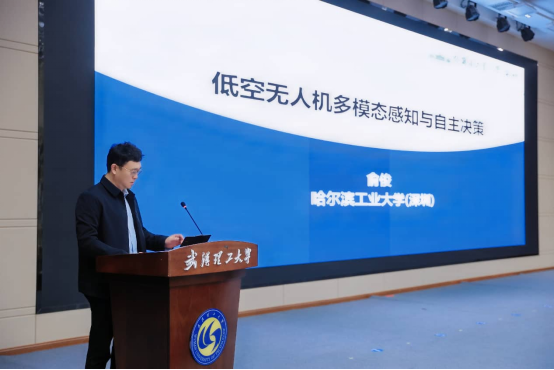
Professor Yu Jun from Harbin Institute of Technology (Shenzhen) delivered a report titled “Multimodal Perception and Autonomous Decision-Making for Low-Altitude Unmanned Aerial Vehicles.” He systematically introduced recent technological advances in how drones integrate multimodal information such as vision and radar for environmental perception and real-time decision-making in complex low-altitude environments.
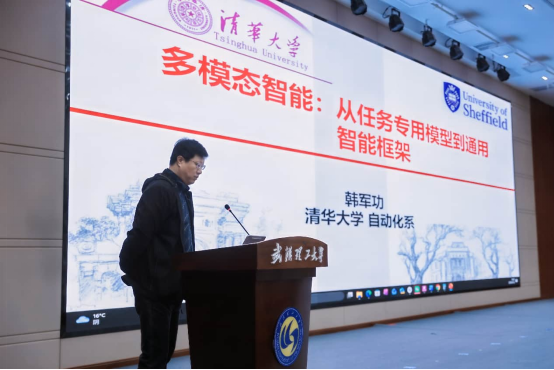
Professor Han Jungong from Tsinghua University delivered a report titled “Multimodal Intelligence: From Task-Specific Models to General Intelligence Frameworks.” He explained the core pathway and technological breakthroughs in the evolution of multimodal intelligence from task-specific models toward general and generalizable intelligence frameworks.
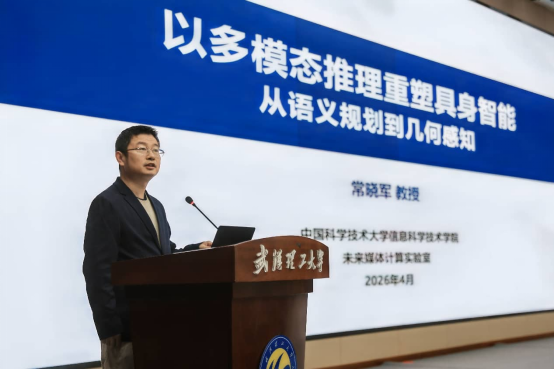
Professor Chang Xiaojun from the University of Science and Technology of China delivered a report titled “Research Progress and Challenges in Embodied Intelligence for Physical Interaction.” Focusing on the perception-decision-action loop in embodied intelligence during interaction with the physical world, he analyzed current technological bottlenecks and future directions.
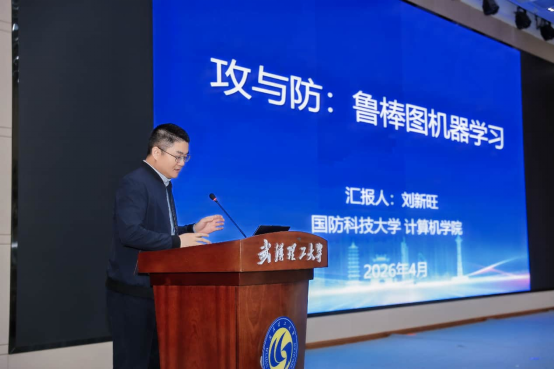
Professor Liu Xinwang from the National University of Defense Technology delivered a report titled “Attack and Defense: Robust Graph Machine Learning.” From the perspective of adversarial attacks and defenses, he systematically discussed key issues and response strategies related to the security and robustness of graph machine learning.
The successful hosting of the “CSIG Image and Graphics China Tour” event at Wuhan University of Technology not only demonstrated the university’s disciplinary strength and academic influence in the fields of computer science and artificial intelligence, but also provided a high-level exchange platform for promoting the interdisciplinary integration of multimodal intelligence and embodied intelligence, as well as collaborative innovation among industry, academia, and research.
Graphics and Text: Ni Zi’ang
Reviewed by: Zheng Bolong
Quick Links






Telephone:+86-27-87216780
Postcode:430070
Email:jsjznxy@whut.edu.cn
Copyright © School of Artificial Intelligence